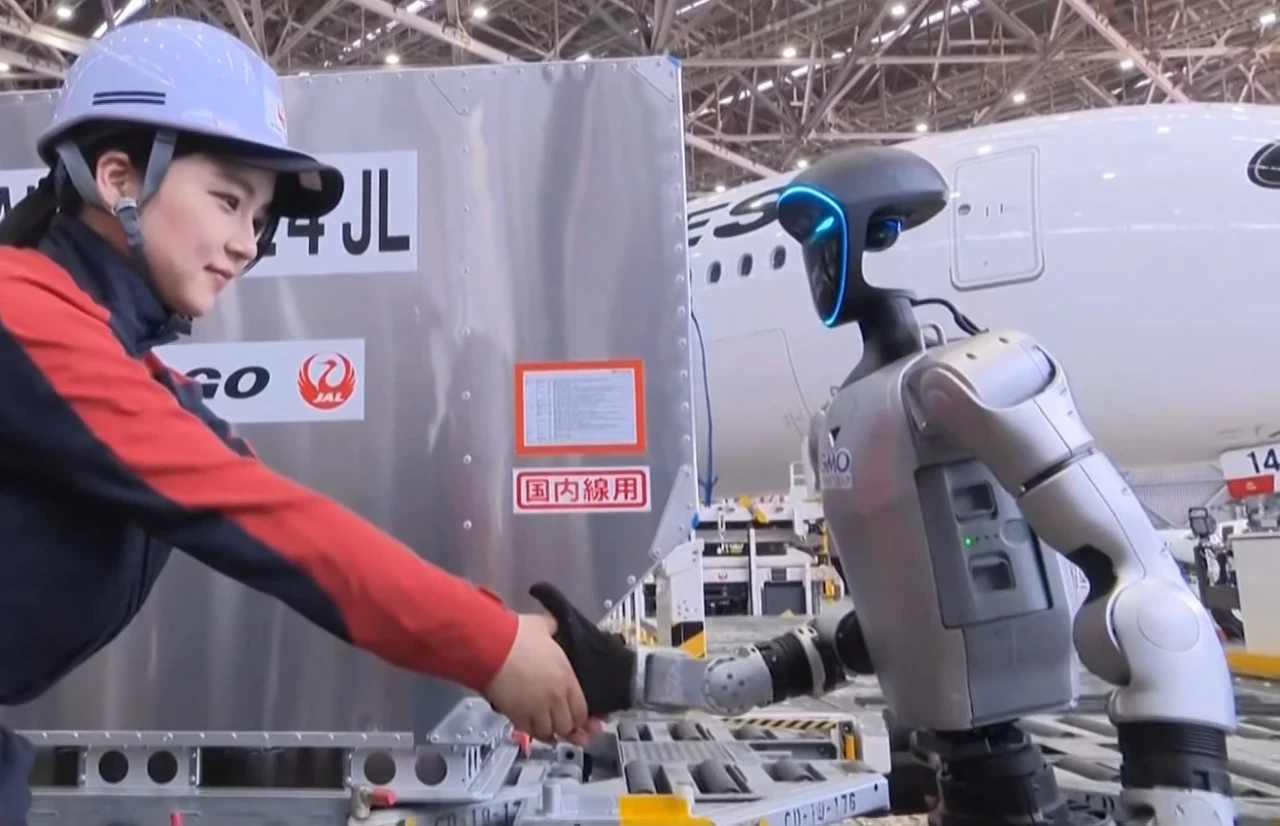
JAL Is Trialling Humanoid Robots for Ground Handling. Yes, Really.
JAL is trialling humanoid robots for baggage handling and ground ops from May 2026. Here's what the experiment actually involves and what to expect.
Japan Airlines announced last week that it's beginning an experiment with humanoid robots at Japanese airports — the first of its kind in Japan — starting in May 2026. The robots are being developed in partnership with GMO AI & Robotics, a company that has apparently designated 2026 as the "First Year of Humanoids." Depending on your outlook, this is either very exciting or the opening of a science fiction novel.
The robots are designed to handle ground operations like loading and unloading baggage, aircraft towing, cabin cleaning, and more. The reason they're humanoid rather than purpose-built machines is because human-shaped robots can work within existing airport infrastructure without modifications to facilities or aircraft.
Why This Is Actually a Real Problem
The announcement frames all of this as a response to a genuine labor crisis. Ground handling in Japan — and globally — is facing serious staffing shortages driven by an aging and shrinking working-age population. Ground handling is physically demanding and has historically been difficult to automate because the work happens in complex, variable environments around aircraft.
A conveyor belt can move bags but can't adapt when a gate changes or a tug needs repositioning. That's where the humanoid form factor comes in. The same spatial adaptability that makes humans effective in irregular environments is, in theory, makes a humanoid robot more capable in the same space than a single-function robot. Whether the technology is actually there will remain to be seen.
What It Might Mean for Travelers
Faster baggage handling and fewer delays from ground crew shortages is goal. A pessimistic read is that this is a decade-long R&D project that produces a very expensive way to load baggage.
The honest answer is probably somewhere in between. Ground handling automation has been coming for years in various forms — like automated baggage systems or robotic aircraft tugs — and humanoid robots represent the next phase of that progression.
The next time you're sitting at Haneda watching the tug push back or bags get loaded, there's now a chance — a small one — that the operator is not entirely human. That's an exciting development and will be one to watch.
Source: JAL Press Release.